
A Fresh (but Obvious) Perspective on My “Winning Teams” Trilogy
Posted on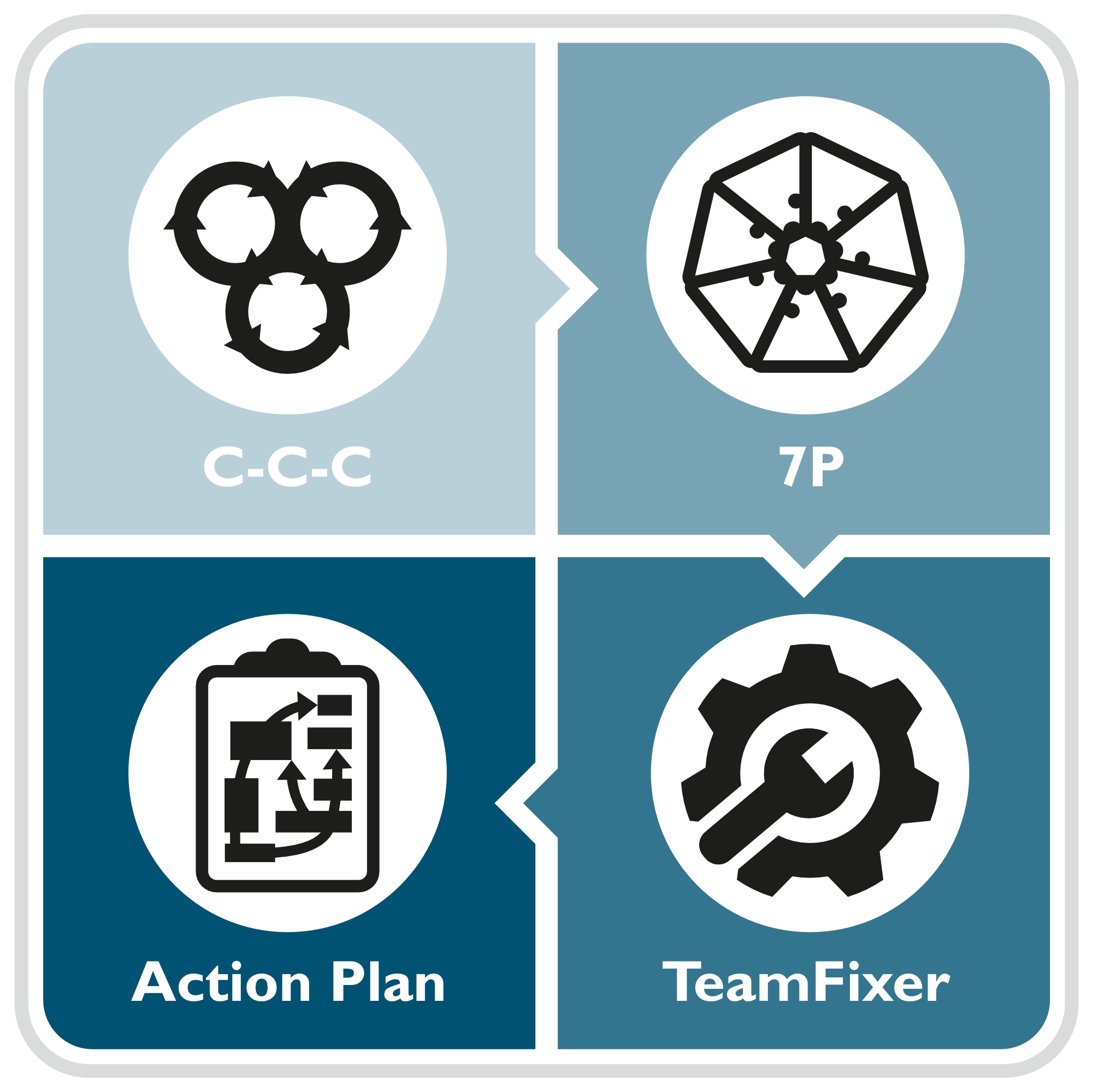
I realise this will be obvious to readers of the three books in my How To Build Winning Teams Again And Again trilogy (2024, Hawkhurst Publishing). But nevertheless I feel it’s worth saying explicitly.
Three of the four models I’ve introduced in the trilogy combine to form an integrated framework. You could call it an “integrated suite”.
Which of the models am I referring to? The Team Progression Curve, the Commit-Combust-Combine (C-C-C) psychological model (both described in Book 1), and the Seven-Principle (7P) Action model described in Book 2.

In Book Three of the trilogy, I implied that they integrate to become one combined suite. On page 15 of that book, in chapter 22, “About Book Three”, I wrote this:
“In this third book we’ll go beyond mere intellectual understanding and see how to apply the second book successfully. Book Three is therefore the ‘how to’ comparison to Book Two. It shows how to diagnose what’s happening in your team using the TeamFixer® tool, figure out which of the seven principles to focus on, and how to sequence your actions to best effect in three scenarios: (1) A new team (2 An existing team that’s doing okay but needs to do better. (3) A team with serious problems.
It goes on to say:
“If you’re a coach, it’ll explain how to apply the C-C-C and 7P models with clients. Finally, it offers you an FAQs chapter. I’ve answered 40 practical questions asked by people like you who work in teams, people I’ve worked with over the last 19 years as their coach.”
Now in fact, you don’t needn’t be a coach. You can instead be a team leader or a team member helping to facilitate the process of transitioning from ordinary work group to genuine team. But that’s by the by.
My big point here is that the three main models combine to form an integrated framework. If I was to summarise it, it would go like this:
- Work on action principle #1 (Motivating Purpose) to decide the most important thing your team needs to achieve in the next 12 months.
- From that, zero in on action principle #2 to decide whether you need to operate as a real team or whether a performance group (a less demanding format) will be sufficient to meet your goal.
- Having done that, the idea is to use the C-C-C model to figure out which psychological issue is to the fore and then map across to the Seven-Principle model, using the TeamFixer tool, to see which action keys from the 7P model are most relevant to that issue.
- Thus, the TeamFixer tool integrates the three models into one united framework. (The TeamFixer tool is free and fully explained in Book 3. If you want to download a PDF version of it you can do so from the Tools page on this site.)
So you could say it is “psychology first, action second”. That helps you make sure that what you’re doing is most time-efficient and therefore more likely to bring the fastest results.
And that’s it. An integrated framework. Three models – the Team Progression Curve, the Commit-Combust-Combine psychological model and the Seven-Principle action model – tied together with the TeamFixer® tool to form one cohesive suite.
Let me know if you have any questions or comments. I’d love to hear from you.


