
The Senior Management Team That Shouldn’t Exist
Posted on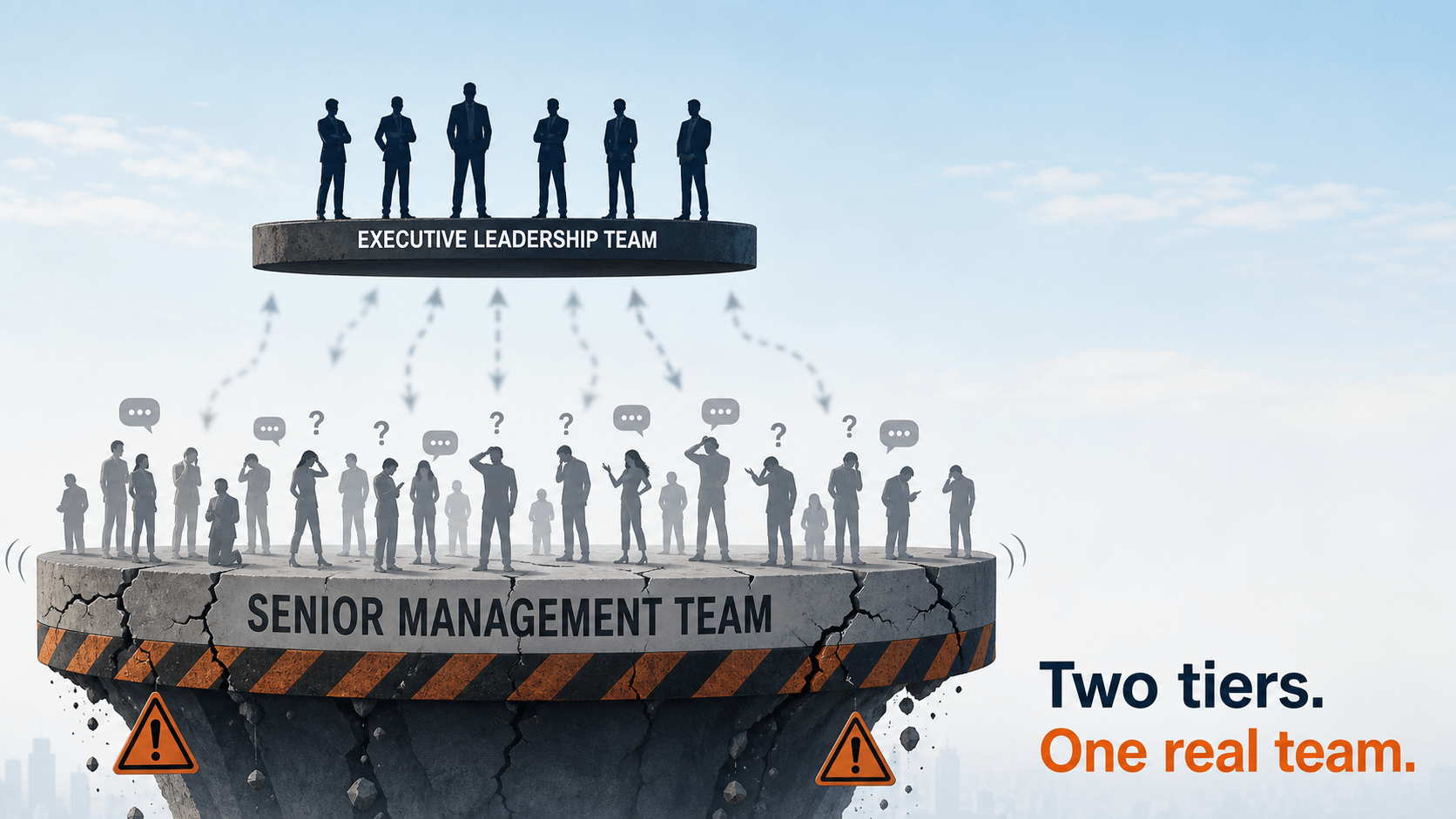
Over the last five years, across more than ten client organisations in different industries, I’ve watched the same strange leadership team “fashion” appear—and fail—every single time. Its the pattern of creating a senior management team that shouldn’t exist.
It looks modern. It sounds impressive. In practice, it quietly backfires.
The fashion goes like this:
You create a Top team, often called the Executive Leadership Team (ELT). Then you create a second, larger “team” beneath or around it, often called the Senior Management Team (SMT). Sometimes it’s the layer immediately below the ELT. Sometimes it’s a mixture of ELT members plus their direct reports. Either way, you now have two tiers of “leadership teams”.
On paper, that sounds sophisticated. In practice, it’s usually a mess.
The Benevolent Idea Behind the Fashion
Let’s be fair: the intent is usually benevolent, even admirable.
CEOs say they need a bridge between strategy and operations … or a cross-functional forum for better collaboration … or a pipeline of future executives … or a way to spead real ownership of the whole organisation. And they want senior people to feel part of something bigger than their own function.
So they create a Senior Management Team (SMT)
They invite 10–20 people. They schedule monthly or quarterly meetings. They say it’s about “sharing strategy”, “building alignment”, “owning the whole organisation, not just your silo”.
It sounds good in the boardroom. It looks good on a PowerPoint. It impresses consultants.
But then reality walks into the room…
What I Keep Seeing, Again and Again
Here’s what I see every time this two‑tier system appears.
- The SMT members don’t know why the group exists.
- They attend long meetings they quietly describe as pointless.
- They sit through high‑level presentations and vague discussions.
- They wonder why they’re there and what, if anything, they’re supposed to do — and leave without answers.
Meanwhile, the ELT starts complaining:
– “The SMT isn’t contributing enough.”
– “They sit there passively.”
– “They don’t show ownership of the whole organisation.”
And then something predictable—and corrosive—happens.
The SMT starts resenting the ELT.
They feel talked at, not listened to.
They feel responsible for everything but empowered for nothing.
They experience the SMT as a symbolic “leadership forum” with no real mandate, no distinctive work and no decision rights.
The ELT sees a lack of contribution.
The SMT sees a lack of purpose.
Both are right. The structure guarantees both.
I have never, in any industry, seen this two‑tier ELT/SMT system work as intended.
The Design Problem Nobody Names
Most leaders treat this as an attitude problem.
“If only the SMT were more engaged.”
“If only they spoke up more.”
“If only they cared more about the whole organisation.”
That diagnosis is wrong.
The problem isn’t their attitude. The problem is the design.
You have called a group a team when it has:
- No clear, distinctive purpose.
- No unique, non‑overlapping responsibilities.
- No goal that belongs to them.
- No authority to act without looking up for approval.
In other words: they are not a team.
They are a pointless talking shop.
You have created a ritual: “Senior Management Team Meeting”. People attend, listen, nod, and leave with vague expectations to “own the whole company”, but no concrete work that is uniquely theirs.
Then you’re surprised when it breeds frustration and learned helplessness.
What I Told a CEO
A CEO asked me recently what to do about exactly this situation.
They had an ELT. They had created an SMT. The SMT was disengaged and resentful. The ELT was frustrated and blaming them. Everyone was tired. Nobody was clear.
Here’s what I told that CEO, and it’s what I would tell any leader considering or already running this two‑tier system:
“I’ve never seen this two‑tier team system work anywhere.
But if you’re determined to keep it, you must give the lower‑tier team a clear purpose and, more than that, a clear goal to achieve that is uniquely theirs and can be achieved without constantly seeking your approval.
If you can’t clarify their purpose and number one goal in a way that is distinctive and motivating for them, then forget the whole thing and abolish that second tier.”
The Test
That’s the test.
Can you, in one sentence, state a clear, distinctive, motivating purpose for your SMT—one that is not simply “be aligned” or “support the ELT”?
Can you define one primary goal that belongs to them, that they can drive and deliver without endless upward permission?
If you can’t, then you don’t have a second leadership team.
You have a recurring senior meeting that wastes time and damages trust.
Don’t Create Senior Management Teams That Shouldn’t Exist
So here’s my challenge to CEOs and executives:
Before you create—or continue running—a Senior Management Team, ask yourself three blunt questions:
- Why does this second‑tier team exist at all?
- What is the one goal it owns that the ELT does not?
- What authority does it have to pursue that goal without constantly looking upwards?
If you don’t like your answers, don’t “improve the meetings”.
Abolish the second tier.
You’ve created a senior management team that shouldn’t exist.
Leadership isn’t strengthened by adding more chairs to the table.
It’s strengthened by giving each table a job only it can do.
If you want to know more about why we have so few successful top teams, take a look at the first book in my trilogy, How To Build Winning Teams Again And Again.


